
No.001
THERE WERE HUNDREDS OF DRINKS In KOREA
Korea Always Had Its Own Drink
ESSAY · INTERVIEW
Two hundred years ago you could have walked clear across Korea and tasted a different wine in almost every house. Not bought — made: each home brewed its own, much as a French farmhouse once pressed its own cider, or an English one kept its own ale.
One wine for the ancestors, one for a wedding, one for the first frost — and no two cups were quite alike. Then, within a single lifetime, almost all of it vanished. Not slowly, and not by accident. This is the story of how that happened — and of the people, today, quietly bringing it back.
A Country That Brewed at Home
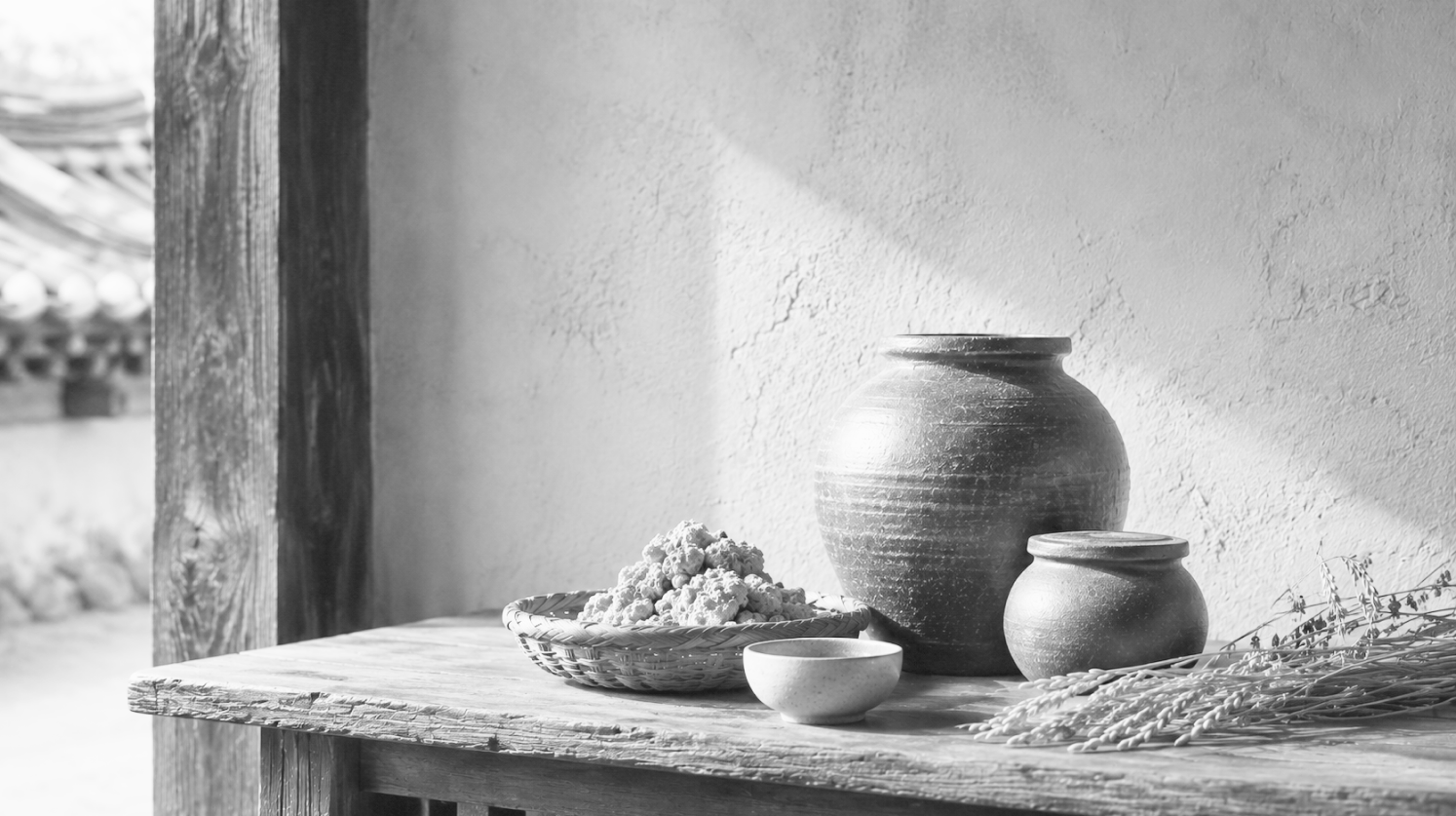
Step into a Korean house two centuries ago and, somewhere out of the way — a cool back room, a shaded corner of the yard — you would find a fat earthenware jar breathing quietly under a cloth. This was the family’s 술독 suldok, its brewing pot. Inside, three plain things were at work: rice, water, and a crumbled cake of 누룩 nuruk, a ferment that draws its wild yeasts straight from the air of the room. Over days, without hurry, they were turning into wine.
Almost every household did this, and the craft had its own name — 가양주 gayangju, “house brew.” It was as everyday, and as personal, as baking bread. Each family kept its recipe like a small inheritance: a wine for the ancestral rites, a wine for a wedding, a wine to greet the first snow. You could tell whose home you were in by the taste in the cup. Europe knew a faint version of this in its farmhouse ciders and country wines — but the Korean variety was staggering. By the written record alone there were more than six hundred of these wines; and until the nineteenth century, not a drop was licensed or taxed. Koreans simply brewed.
Cut Off, Twice Over
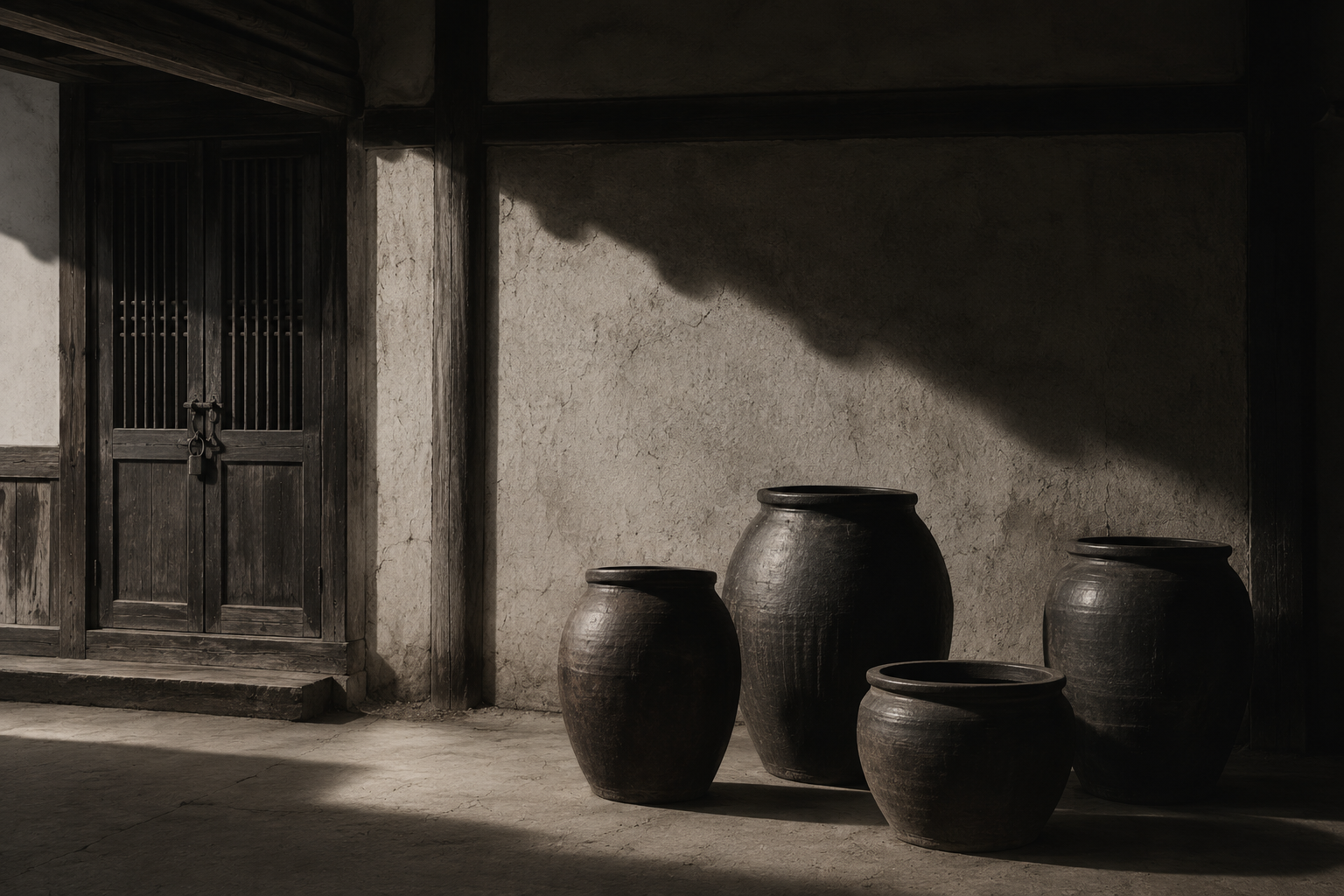
Then the tax man came. Under Japanese colonial rule, brewing was pulled under licence and tax — first in 1909, and then, in 1916, under a rule that did the quiet damage: it set a minimum batch size so large that only a commercial brewery could meet it. A family making wine for its own table simply could not. To brew at all you now needed a permit — and before long, the permits for home brewing were withdrawn altogether.
The rest reads like a slow countdown. The households licensed to brew at home fell year after year — from more than three hundred thousand, down and down, until by 1932 a single licence was left in the entire country, held by one man. When he died, two years later, the number reached zero. What had simmered in every kitchen for centuries was now, suddenly, against the law. Those who kept on did it in the dark — 밀주 milju, moonshine, hidden from the inspectors, as poteen was hidden in Ireland and moonshine in the American hills.
Then, after the war, a second blow. In 1965, with rice scarce, the government forbade its use in alcohol altogether. Picture a clear rice wine like Sidasyeo — nothing but rice, water and 누룩 nuruk — and the loss is plain: its one essential ingredient, gone overnight. The refined rice wines and the old pot-distilled soju collapsed, and cheap factory soju moved into the empty space. Europe has seen a drink killed by decree before — absinthe, outlawed across much of the continent around 1915 and lost for nearly a century — but here it was not one drink; it was most of a tradition. Even the names slipped away: the imported sake style took the word 청주 cheongju, while Korea’s own clear wine was filed under 약주 yakju.
A thread cut is not a thread erased. You can find the end, and tie it again.
The Thread, Picked Back Up
A thread cut is not a thread erased. In the mid-1990s, brewing for your own table became legal again — a full century after it was forbidden. Then, in 2017, came a curious gift: of all the drink in Korea, traditional liquor alone could be sold online, so a maker in one small village could suddenly reach the whole country.
The revival has come from two directions. Some are restorers, bringing lost wines back from the page. Researchers sat down with cookbooks five centuries old — among them the 산가요록 Sangayorok, written in the 1400s, holding the oldest drink recipes Korea still has — and brewed their way back to wines no living person had tasted. It is the same instinct that has sent European brewers back to medieval herb ales and lost monastery recipes. Byeokhyangju, once the pride of Pyongyang, was lifted straight off the page and poured again.
Others simply fell in love with the drink. The founder of a new brewery in Yongin had spent a full career in IT security; only after he retired, later in life, did he taste a near-forgotten wine called hosanchun — and find he could not let it go. In retirement he set about learning the old method, and his brewery, Dudumulmul, now pours that reconstructed wine, and beside it a tart, living cousin called Sidasyeo — the very kind of clear rice wine the 1965 ban had silenced, back in the glass. And some reinvent rather than restore: Eotteonharu, “a certain day,” is a yuzu wine from a young maker — the fragrant southern citron, bottled bright and modern for a table that has never met it.